
AI Voice Agents: How They Work, Costs, and Use Cases

If you have called a business recently and had a conversation that felt surprisingly natural, there is a good chance you were talking to an AI voice agent.
AI voice agents are software systems that handle phone conversations in real time. They use speech recognition to understand the caller, language models to work out what the caller needs, and text-to-speech to respond.
Unlike traditional IVR systems, there is no fixed menu. Instead of “Press 1 for billing, press 2 for sales,” a voice agent listens to the request, asks follow-up questions, pulls information from business systems, takes action, and keeps the conversation going.
The technology has improved a lot over the past 18 months. Responses are fast enough for natural conversation, voices sound far more realistic, and handling routine calls can cost much less than relying only on live agents. For businesses with high call volumes, that combination is what makes voice AI worth a serious look.
At Contrive, we built our own voice agent platform after deploying voice AI for clients in customer support, sales, and appointment scheduling.
This guide covers how the technology works, where it creates real business value, what voice agent costs look like, how implementation runs, and the challenges to plan for.
How Do AI Voice Agents Differ from IVR and Chatbots?
Voice agents overlap with IVR systems and text chatbots, but callers interact with them very differently.
| Feature | Traditional IVR | Text Chatbot | AI Voice Agent |
|---|---|---|---|
| Input | DTMF tones and button presses | Typed text | Natural speech |
| Understanding | Fixed menu trees | Intent matching | Natural language understanding with context |
| Response | Pre-recorded audio | Generated text | Real-time synthesized speech |
| Conversation flow | Linear and rigid | Branching but usually scripted | Dynamic and adaptive |
| System integration | Limited | Moderate | CRM, calendars, databases, APIs and other systems |
| Handles interruptions | No | N/A | Yes |
| Emotional awareness | None | Limited sentiment analysis | Tone detection and response adjustment |
In practice, IVR makes callers follow the company’s menu, chatbots make them type, and voice agents let them explain what they need in their own words.
For example, imagine a customer saying:
“Yeah, I received this bill and something doesn’t look right. The amount is much higher than last month.”
An IVR system has almost no context to work with. A voice agent can tell this is a billing question, open the customer’s account, compare the invoices, and continue the conversation based on what it finds. That makes voice AI useful whenever questions do not fit neatly into menu options, and it is a big part of why it improves customer experiences on the phone.
How Does the Voice Agent Technology Stack Work?
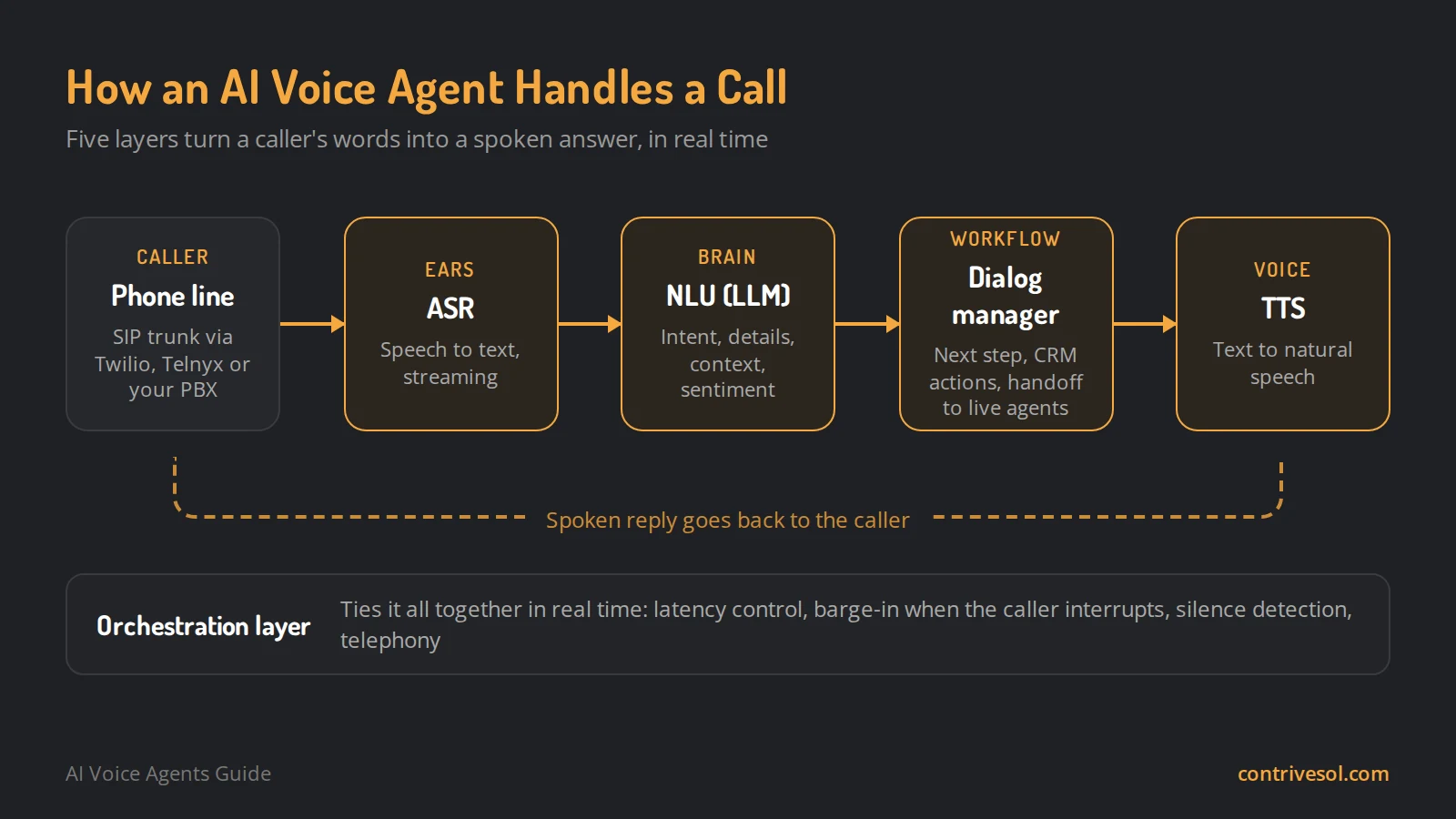
A voice agent has to hear the caller, understand what they mean, decide what to do, and respond quickly enough that the conversation still feels natural. Five connected layers make this possible.
Automatic Speech Recognition (ASR)
Automatic Speech Recognition, or ASR, converts speech into text. Think of it as the system’s ears. Common providers:
Deepgram is our default choice in many deployments. Its streaming transcription offers low latency, strong accuracy across different accents, and competitive pricing at scale.
OpenAI Whisper provides strong transcription accuracy, particularly for accented English. Traditional batch processing can introduce more latency, although real-time implementations have improved significantly.
Google Cloud Speech-to-Text is a mature option with broad language support and well-established cloud infrastructure. It can be a good choice for multilingual deployments.
AssemblyAI performs well in noisy environments and also offers useful capabilities such as speaker diarization when identifying different speakers is important.
No single provider is best for every project. The right choice depends on accuracy needs, languages, expected call volume, and latency tolerance. For English-focused deployments, Deepgram is usually the best balance of speed, accuracy, and cost.
Natural Language Understanding (NLU)
Once speech becomes text, the NLU layer works out what the caller means. In modern voice agents this is usually an LLM, and it handles:
- Intent recognition: Understanding that “I want to cancel my subscription” is a request to start a cancellation process.
- Entity extraction: Identifying information such as account numbers, dates, product names, and amounts.
- Context tracking: Remembering information from earlier in the conversation when the caller refers to something indirectly.
- Sentiment analysis: Detecting signs of frustration, confusion, or urgency so the agent can respond appropriately or escalate the call.
We use GPT-4o or Claude as the NLU backbone for many deployments because they handle ambiguity and conversational context well.
For high-volume applications with relatively simple conversations, smaller fine-tuned models can also be considered to reduce operating costs.
Dialog Management
Dialog management controls the conversation: what has happened, what information has been collected, and what comes next. It covers:
- Conversation state: Tracking where the caller is in the workflow.
- Multi-turn conversations: Managing information that is provided over several exchanges.
- Action selection: Determining whether the agent should ask another question, call an API, perform an action, transfer the caller, or finish the conversation.
- Guardrails: Preventing the agent from making unauthorized commitments, exposing restricted information, or moving outside approved workflows.
We use LangGraph for many dialog management implementations because it provides explicit control over conversation states, branching logic, and human handoff conditions.
For simpler applications, a well-designed system prompt combined with function calling can be enough.
Text-to-Speech (TTS)
Text-to-Speech, or TTS, turns the agent’s response into spoken audio. This is where voice AI has improved the most, and modern voices sound far more natural than the robotic ones people associate with phone systems. Common options:
- ElevenLabs: Known for highly expressive and natural voices, with support for custom voice creation.
- PlayHT: A strong alternative with multilingual capabilities and competitive latency.
- Azure Neural TTS: An enterprise-oriented option with SSML support for controlling pronunciation, pacing, and emphasis.
- OpenAI TTS: A straightforward option with good quality and relatively simple implementation.
- Deepgram Aura: Designed specifically for real-time conversational applications.
Voice selection deserves more attention than most teams expect. A professional, authoritative voice suits B2B sales, while customer support usually benefits from a calm, friendly, patient one.
Orchestration Layer
The orchestration layer connects these components and manages the real-time flow from incoming audio to outgoing speech. It has to solve:
Latency optimization: The system needs to recognize, process, and respond quickly. Streaming ASR, chunked TTS, connection pooling, and other techniques help reduce the delay.
Barge-in detection: Callers do not always wait for an agent to finish speaking. If someone interrupts, the system needs to stop speaking and listen immediately.
Silence handling: The system needs to distinguish between a short pause while someone is thinking and the end of their turn.
Telephony integration: Voice agents need to connect to the phone infrastructure. This can be done through SIP trunking providers such as Twilio, Vonage, or Telnyx, or through direct PBX integration for certain enterprise environments.
Callers never see these details, but they decide how natural the conversation feels.
Where Are Voice Agents Creating Real Business Value?
Across our deployments, the strongest business cases show up in a few areas. The point is not replacing people with AI. It is finding calls that are repetitive, predictable, and time-consuming, and automating those.
Customer Support: Tier 1 Resolution and After-Hours Coverage
Many support calls follow predictable patterns: checking an order, asking about an account, resetting a password, starting a return, or troubleshooting a basic problem. These are good candidates for automation.
Say a customer calls at 11 PM because a shipment has not arrived. The voice agent verifies their identity, pulls up the order, checks carrier tracking, explains the status, and offers to text the tracking link. If the issue needs a person, it transfers the call to one of your live agents.
After-hours coverage is especially valuable. Instead of voicemail or “please call back during business hours,” customers get help around the clock.
Sales: Outbound Prospecting and Lead Qualification
A voice agent can make hundreds of outbound calls per day, deliver a consistent introduction, handle common objections, qualify prospects according to predefined criteria, and book meetings directly on a sales team’s calendar.
We deployed a sales voice agent for a client that was spending approximately $210,000 per year on three SDRs for initial outreach and appointment setting.
The voice agent now handles the same type of outbound activity, books more qualified meetings, and costs approximately $2,500 per month to operate.
The goal is not to replace the people who close deals. The agent takes the repetitive prospecting and qualification work so experienced reps spend their time on qualified opportunities.
Appointment Scheduling
Clinics, dental offices, real estate agencies, and professional services firms field a lot of calls about availability and bookings. A voice agent can answer, check the scheduling system, offer open slots, book the appointment, send a confirmation, and set reminders. With the right integrations it can also handle insurance verification and intake.
One healthcare client reduced no-show rates by 35% after using a voice agent for reminder calls and rescheduling.
The win is less friction when changing an appointment. Customers call, say what they need, and the system handles the rest.
Surveys and Feedback Collection
Voice agents also work well for post-call CSAT surveys, NPS collection, and other feedback workflows. Unlike a fixed automated survey, a conversational agent responds to what the customer actually says.
If a customer answers, “Actually, I wasn’t happy with my last interaction,” the agent can ask a follow-up question, capture the specifics, and even trigger a call from a manager. That is far more useful than a string of yes-or-no questions.
How Do Voice Agent Costs Compare to Human Agents?
Cost is one of the main reasons businesses look at voice AI. Exact numbers vary by call volume, model choices, and infrastructure, but the gap can be large.
| Cost Factor | Human Agent | AI Voice Agent |
|---|---|---|
| Hourly cost | $25 to $45/hr in the US, $8 to $15/hr offshore | Approximately $0.05 to $0.15/minute |
| Availability | Scheduled shifts, PTO and sick days | 24/7/365 |
| Ramp-up time | Typically 2 to 6 weeks | Once deployed, capacity can be added quickly |
| Consistency | Varies by individual and workload | Consistent execution within the configured workflow |
| Scalability | Requires hiring and training | Additional capacity can be added quickly |
| Calls per day | Approximately 40 to 60 | 500+ with parallel processing |
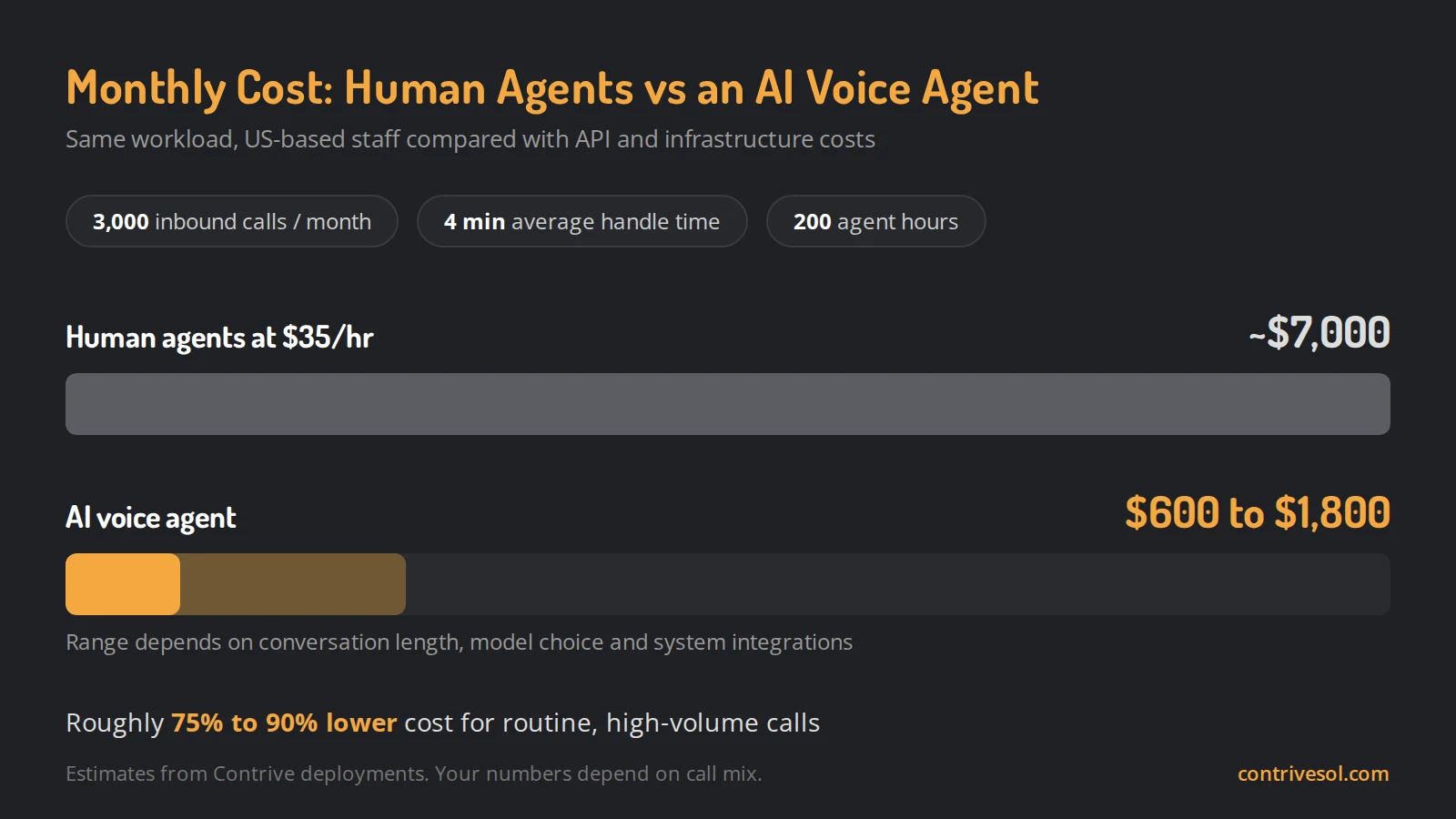
Take a business handling 3,000 inbound calls a month at four minutes each. That is about 200 hours of agent time, or around $7,000 a month at $35 per hour for a US-based agent. A voice agent handling the same calls would cost roughly $600 to $1,800 a month in API and infrastructure costs, depending on how complex the conversations are.
Typical operating costs include:
- LLM API calls: Approximately $0.01 to $0.05 per conversation turn, depending on the model.
- ASR: Approximately $0.004 to $0.02 per minute of audio.
- TTS: Approximately $0.10 to $0.30 per 1,000 generated characters.
- Telephony: Approximately $0.01 to $0.03 per minute through providers such as Twilio or Telnyx.
- Infrastructure: Approximately $200 to $800 per month for hosting and monitoring.
All in, a call costs roughly $0.15 for a short, simple interaction and $0.80 or more for a longer conversation with several system actions. Use these figures for a first ROI estimate, then recalculate with your own call volume, call length, model usage, and integrations.
What Does Implementation Look Like?
Building a voice agent is more than connecting a phone number to an LLM. A reliable deployment needs conversation design, integrations, testing, monitoring, and a clear path to human escalation.
Timeline
| Deployment Type | Timeline | Description |
|---|---|---|
| Basic inbound agent | 4 to 6 weeks | Single use case, 1 to 2 integrations, standard voice |
| Multi-use-case agent | 6 to 10 weeks | Multiple call flows, 3 to 5 integrations, custom voice |
| Enterprise deployment | 10 to 16 weeks | Multiple departments, compliance requirements, custom orchestration and PBX integration |
Phase Breakdown
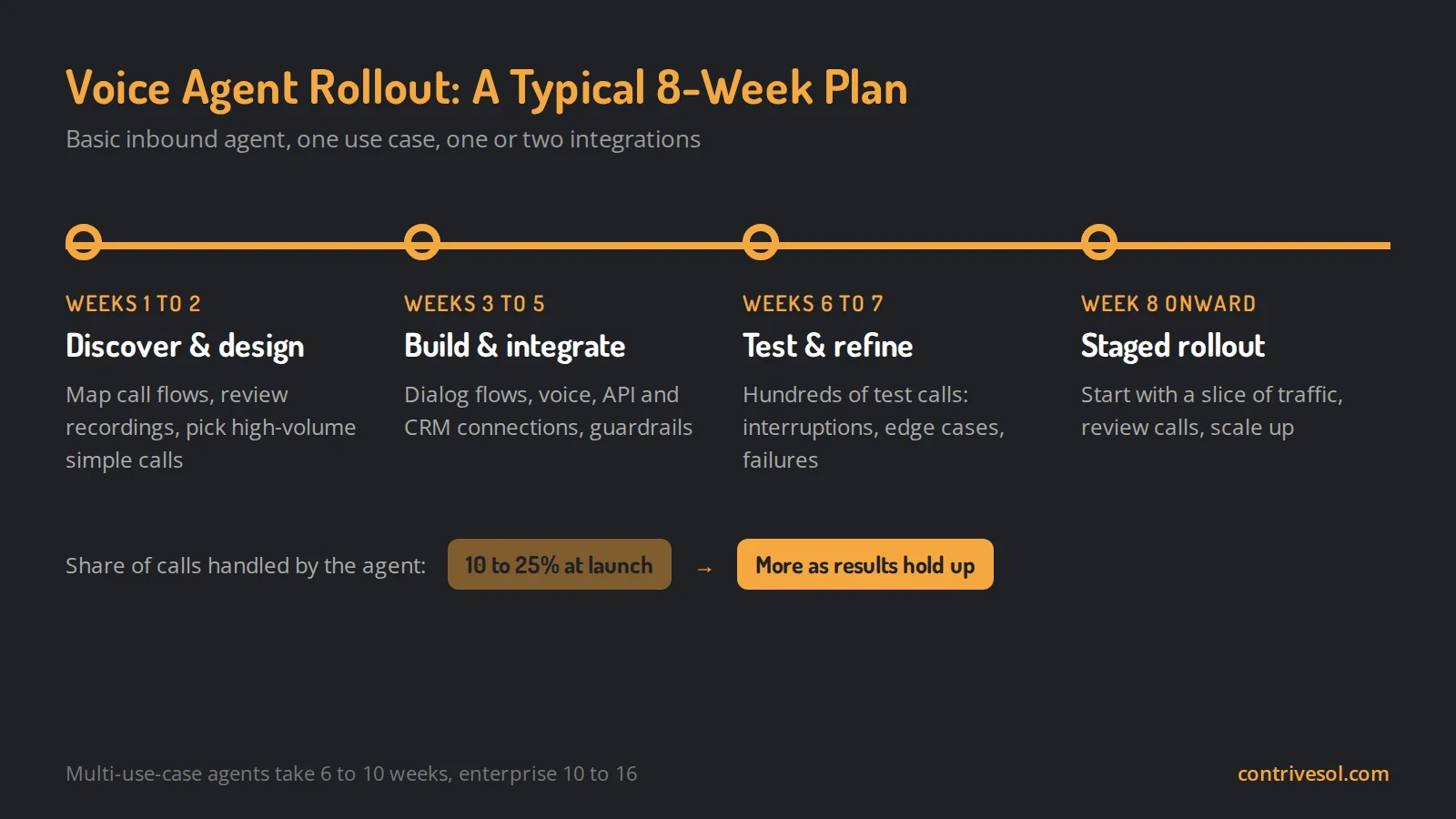
Week 1 to 2: Discovery and design
We map your call flows, review recorded calls where permission has been given, and find the conversations that are both high-volume and fairly simple. Those are the best candidates to automate first.
Week 3 to 5: Build and integrate
Conversation design, system integrations, voice selection, dialog flows, API connections, and guardrails.
Week 6 to 7: Test and refine
Real conversations rarely follow a script, so we test common scenarios, interruptions, unexpected answers, edge cases, and system failures. We typically run hundreds of test calls before going live.
Week 8 and beyond: Staged rollout
We start the agent on a slice of traffic, often 10% to 25% of calls, then review conversations, adjust, and increase the share as confidence grows. Most agents improve a lot in the first few weeks live, because real calls surface situations that are hard to reproduce in testing.
What Are the Real Challenges?
Voice AI is not the right tool for every conversation. Know the limits before deciding where to use it.
Accent and Dialect Handling
Recognition accuracy drops with strong regional accents, non-native speech, and some dialects. We handle this with ASR models that do well across diverse speech, confirmation steps, and fallback paths. If the system is unsure about an account number, it reads it back for confirmation instead of carrying on with bad data. For multilingual deployments, language detection early in the call routes the conversation to the right ASR and TTS models.
Background Noise
People call from cars, airports, restaurants, and construction sites. Noise reduction helps, but it has limits. A well-designed agent handles this gracefully by asking the caller to repeat themselves or suggesting a quieter spot, rather than failing.
Emotional Intelligence
Voice agents can detect frustration in tone and speech patterns, but detecting frustration is not the same as empathy. For billing disputes, serious complaints, and other sensitive calls, the better move is usually to bring in a person.
We set escalation thresholds based on sentiment and conversation context. When one is hit, the agent tells the caller it is connecting them to a specialist and hands the live agent a summary, so the caller does not have to repeat everything.
Regulatory Compliance
Compliance matters most in healthcare, finance, and regions with strict privacy laws. Depending on the application, you may need encrypted audio streams, compliant data storage, consent handling, call recording disclosures, and access controls. For HIPAA-regulated healthcare work, these belong in the architecture from day one, not bolted on later.
We have built HIPAA-compliant voice agents for healthcare clients. Compliance requirements can add several weeks to the implementation timeline and increase costs, but they are essential when the application handles regulated information.
Is a Voice Agent Right for Your Business?
Voice AI tends to make the strongest business case when a company has:
- More than 500 calls per month with reasonably predictable call patterns
- Significant after-hours call volume
- High spending on Tier 1 customer support
- Sales representatives spending substantial time on outbound dialing and qualification
- Appointment scheduling that creates a bottleneck for staff
It may not be the right fit when:
- Monthly call volume is very low
- Most conversations require significant human judgment
- Calls frequently involve sensitive emotional situations
- The business operates in a highly regulated environment but is not prepared to make the required compliance investment
Most businesses sit somewhere in between. The useful question is not “Can AI answer our calls?” but “Which calls should AI handle, and where should a person stay involved?”
A good deployment does not automate every conversation. The best results usually come from automating the repetitive parts of the customer journey while keeping an easy path to a human.
If you are evaluating voice AI for your business, we can help assess whether it makes sense for your specific use case and estimate the potential ROI based on call volume, workflow complexity, integrations, and implementation requirements.
Frequently Asked Questions
How natural do AI voice agents sound in 2026?
Modern AI voice agents can sound very natural, particularly when using high-quality TTS systems such as ElevenLabs or Azure Neural TTS.
For many callers, the voice itself may not immediately reveal that they are speaking with AI.
The bigger challenge is usually how the system handles unexpected questions, interruptions, humor, unusual phrasing, or conversations that move outside the expected workflow.
That is why conversation design and testing are just as important as voice quality.
Can a voice agent handle calls in multiple languages?
Yes.
Multilingual voice agents can detect the caller’s language and switch to appropriate ASR, NLU, and TTS models.
English, Spanish, French, German, Portuguese, and Mandarin currently offer strong quality across the major components of the voice stack.
Other languages can also be supported, although speech recognition accuracy may vary.
Google Cloud Speech-to-Text provides support for more than 125 languages, which can be useful for broader multilingual deployments.
What happens when the voice agent cannot handle a call?
The call can be transferred to a human.
A well-designed voice agent should have clear escalation rules based on factors such as confidence, conversation topic, caller frustration, or system limitations.
Before transferring the call, the agent can provide the human representative with a summary of what has already been discussed.
This allows the human to continue from the existing context instead of asking the caller to start over.
How do you measure voice agent performance?
We typically monitor five core metrics:
- Resolution rate: The percentage of calls resolved without human intervention.
- Average handle time: How long conversations take to complete.
- Caller satisfaction: How callers rate the interaction.
- Escalation rate: How often calls need human assistance.
- Cost per call: The total operating cost associated with each interaction.
We also monitor technical metrics such as ASR accuracy, TTS quality, and response latency.
During the initial deployment period, these metrics help identify where the agent is performing well and where the conversation design needs improvement.
Do I need to replace my phone system to use a voice agent?
No.
Voice agents can often work with existing phone infrastructure through SIP trunking.
Businesses using cloud PBX platforms such as RingCentral, Dialpad, or 8×8 can typically integrate voice AI without replacing their entire phone system.
For on-premise PBX environments, a SIP gateway may be required.
Another option is to use a telephony provider such as Twilio or Telnyx and route only selected numbers or types of calls to the AI agent while keeping the rest of the existing phone system unchanged.
The exact architecture depends on the current phone system, call routing requirements, security requirements, and the type of voice agent being deployed.
- Founded
- 2014
- Years in business
- 12
- People
- 66
- Headquarters
- Lahore, Pakistan
- Projects delivered
- 250+
- AI systems in production
- 10
Address
- 50-C, Commercial Zone Block E PIA Society, Lahore, Punjab
- Danville, CA
What Market Says About Us!