

For a typical B2B SaaS (accounts, teams, billing, background jobs), Laravel ships more of the product as first-party code: two-factor login, teams, Stripe billing and database-backed queues. Node.js, with Express or NestJS, fits better when the product runs on many long-lived connections or the team writes TypeScript end to end. In our same-host example, the monthly bill differs by only $15.
Some comparisons still claim Laravel needs extra tools for real-time features or AI. That’s out of date: Laravel has its own WebSocket server, Reverb, and Laravel 13 added a first-party AI SDK.
Key takeaways
- Laravel’s starter kits include registration, login and TOTP two-factor auth and can be generated with team support. Cashier handles Stripe subscriptions.
- Node.js stays fast while each request’s work is small. One slow callback stalls every client, and Node’s own docs say heavy computation may not be the best fit.
- On the same provider, our example SaaS costs $58.15 a month on Laravel and $73.15 on NestJS. The gap is the managed Redis we priced for NestJS queues.
- In Stack Overflow’s 2026 survey, 46.4% of web-framework respondents used Node.js, 7.6% used Laravel and 5.8% used NestJS.
- In October 2026, PHP shipped critical security fixes with no patch for 8.0 and 8.1, and Laravel Cloud dropped end-of-life Node 20.
What is the difference between Laravel and Node.js?
Laravel is a full-stack PHP framework, and Node.js is a JavaScript runtime. For a SaaS backend, the fair comparison is Laravel against a Node framework, usually Express or NestJS.
Express is the minimal option. It doesn’t force an ORM or template engine on you, so your team picks and wires those pieces itself. NestJS adds a ready-made application structure and runs on Express by default. It still leaves the database layer open: you choose TypeORM, Prisma, Drizzle, Sequelize or another library.
Laravel makes those choices for you. It ships its own ORM, Eloquent, along with the auth, billing and queue pieces covered in the next section. Fewer decisions at the start means less glue code, but it also means working the Laravel way.
On tooling, Node can now run TypeScript files directly by stripping the types, but it does no type checking. It also fails on decorators, which NestJS relies on, so a NestJS project still needs a TypeScript build step.
Which SaaS features come built in?
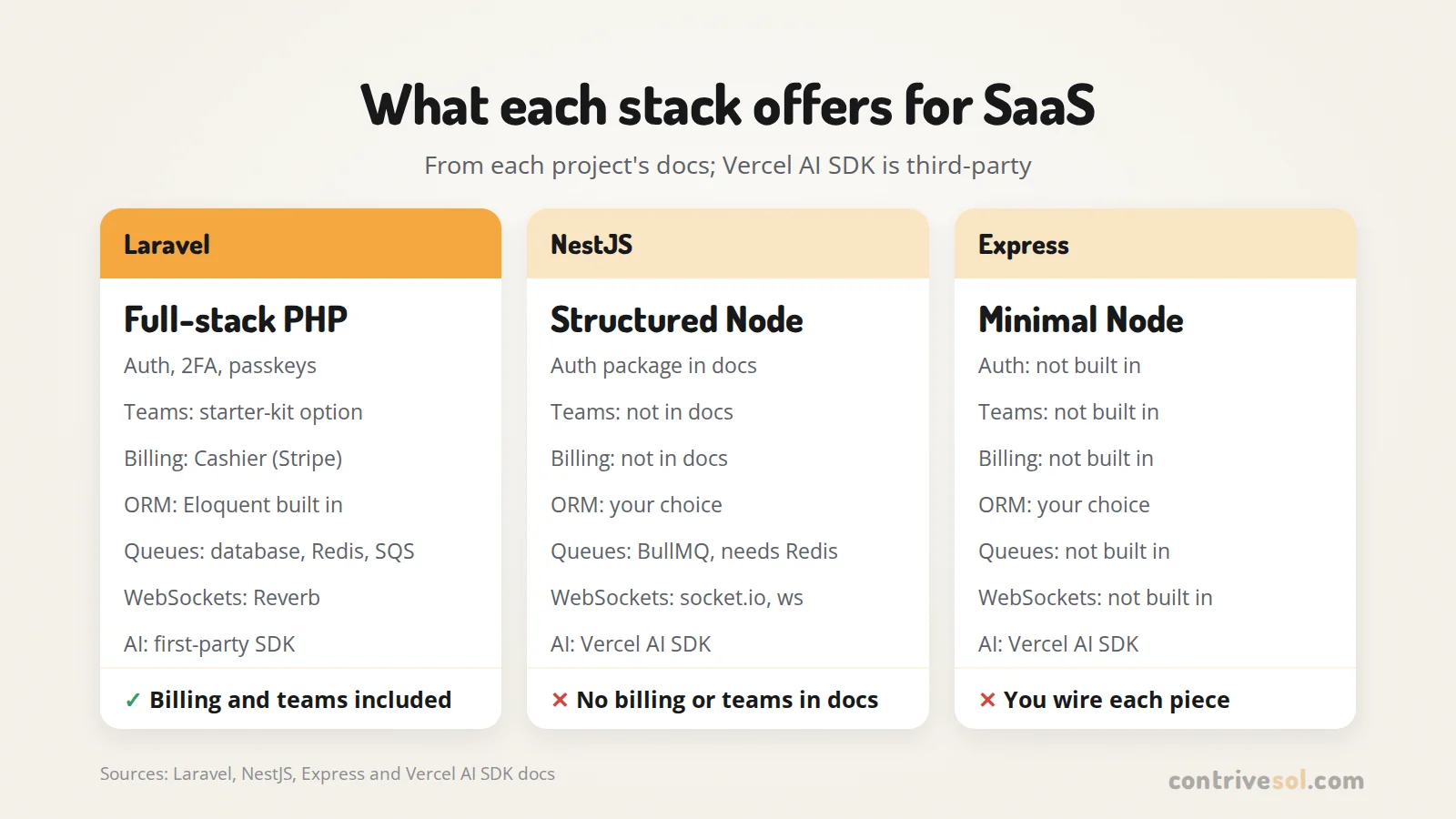
Laravel ships more of a standard SaaS backend as first-party code than NestJS or Express do. The gap is widest in billing and team accounts.
Laravel’s starter kits include the routes, controllers and views for registration and login, plus TOTP two-factor authentication. The React, Svelte, Vue and Livewire kits can be generated with team support, so users belong to teams, receive invites and switch between them. Passkeys arrived in April 2026 as separate first-party packages for the server and the client, with Fortify integration.
For billing, Laravel Cashier handles Stripe subscriptions, including coupons, plan swaps, subscription quantities, cancellation grace periods and invoice PDFs. Queues run on Amazon SQS, Redis or a plain relational database, so an early product can process background jobs without extra infrastructure. Laravel 13 also added first-party JSON:API resources for standard API responses.
NestJS includes WebSocket gateways for socket.io and ws. Its docs now describe a first-party @nestjs/authentication package for sessions, password hashing, 2FA, tokens and API keys, though its release date isn’t confirmed. Its queue tools, BullMQ and Bull, need a running Redis instance. We found no first-party subscription billing or team-account module in the NestJS or Express docs, so a Node team builds those or adds third-party packages.
AI support is now close to even. Laravel 13 ships a first-party AI SDK for text generation, tool-calling agents, embeddings, audio, images and vector stores. It works with OpenAI, Anthropic, Gemini and other providers, and it can run similarity search on PostgreSQL with pgvector from the query builder. Node teams have Vercel’s AI SDK, a TypeScript toolkit for AI apps and agents. Laravel 13 came out in March 2026, so comparisons written before then miss all of this.
Is Node.js faster than Laravel?
In synthetic throughput benchmarks, yes: Express comes out ahead of Laravel. The published Laravel run used MySQL, though, and doesn’t say whether it ran on PHP-FPM or Octane.
Node.js serves many clients with a small number of threads, and it stays fast while the work for each client at any moment is small. If one callback runs too long, every current and new client waits. Node’s own documentation says it excels at I/O-bound work but may not be the best option for expensive computation. In a SaaS, report generation or image processing belongs in a background job, not inside the request.
Classic PHP boots the application fresh for each request. Laravel Octane boots the app once, keeps it in memory and feeds it requests, running on FrankenPHP, Swoole or RoadRunner. The trade-off is Node-style care with memory. Under Octane, adding data to a static array leaks memory, so code and packages need checking before you switch.
If your requests mostly wait on the database or outside APIs, a benchmark ratio tells you little about real response times. Fathom Analytics’ co-founder, who runs the product on Laravel, concluded in 2022 that Laravel is “a fantastic choice for 99.99994%+ of web applications”. That is one practitioner’s view, but the logic holds: pick on features and team first, then tune.
Can Laravel handle real-time features?
Yes. Laravel Reverb is Laravel’s first-party WebSocket server, so live notifications and dashboards don’t need a separate Node service.
Reverb has two limits to plan for. Its default event loop is typically capped at 1,024 open files, so above about 1,000 concurrent connections you need an alternative loop such as ext-uv. A single Reverb server needs no Redis, but running Reverb across several servers uses Redis pub/sub to share connections.
NestJS supports socket.io and ws out of the box, and Node’s event loop suits many open connections where each message needs little work. If real-time is the product itself, such as chat or live collaboration spread over many servers, Node is the more natural fit. If it is one feature among many, Reverb covers it.
Is it easier to hire Node.js or Laravel developers?
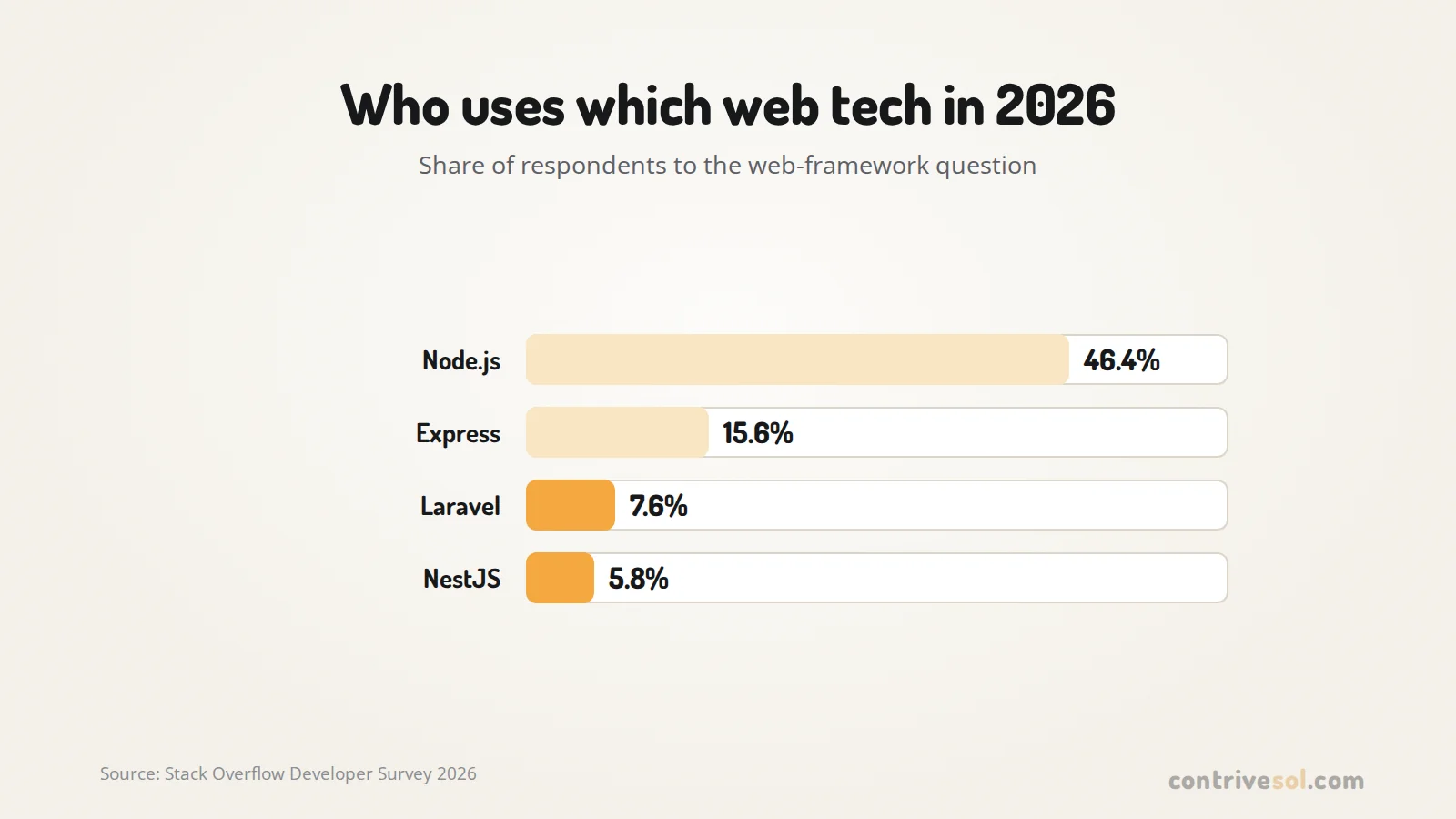
Far more developers use Node.js than Laravel, but fewer use NestJS than Laravel. In Stack Overflow’s 2026 survey, 46.4% of respondents to the web-framework question used Node.js, 15.6% Express, 7.6% Laravel and 5.8% NestJS.
That makes Node about six times as common as Laravel among respondents. For a structured Node backend, the numbers flip. NestJS users are a smaller group than Laravel users in the same survey, so the “bigger JavaScript hiring pool” argument mostly applies to Express and general Node work.
Language numbers point the same way: 62.0% of respondents used JavaScript, 43.8% TypeScript and 17.7% PHP. These figures measure what Stack Overflow survey respondents use, which is not the same as open jobs or salaries.
Staffing cost is harder to pin down. Stack Overflow publishes salaries by role and country, not by language or framework, and its 2026 global median for back-end developers is $85,296. We found no reliable source comparing Laravel and Node.js salaries, so treat claims that one stack is cheaper to staff with caution.
Whether you hire in-house or bring in a team for Laravel or Node.js work, ask for experience with the specific framework. A strong Express developer still has to learn NestJS’s structure.
Can you run a Laravel API with a Next.js front end?
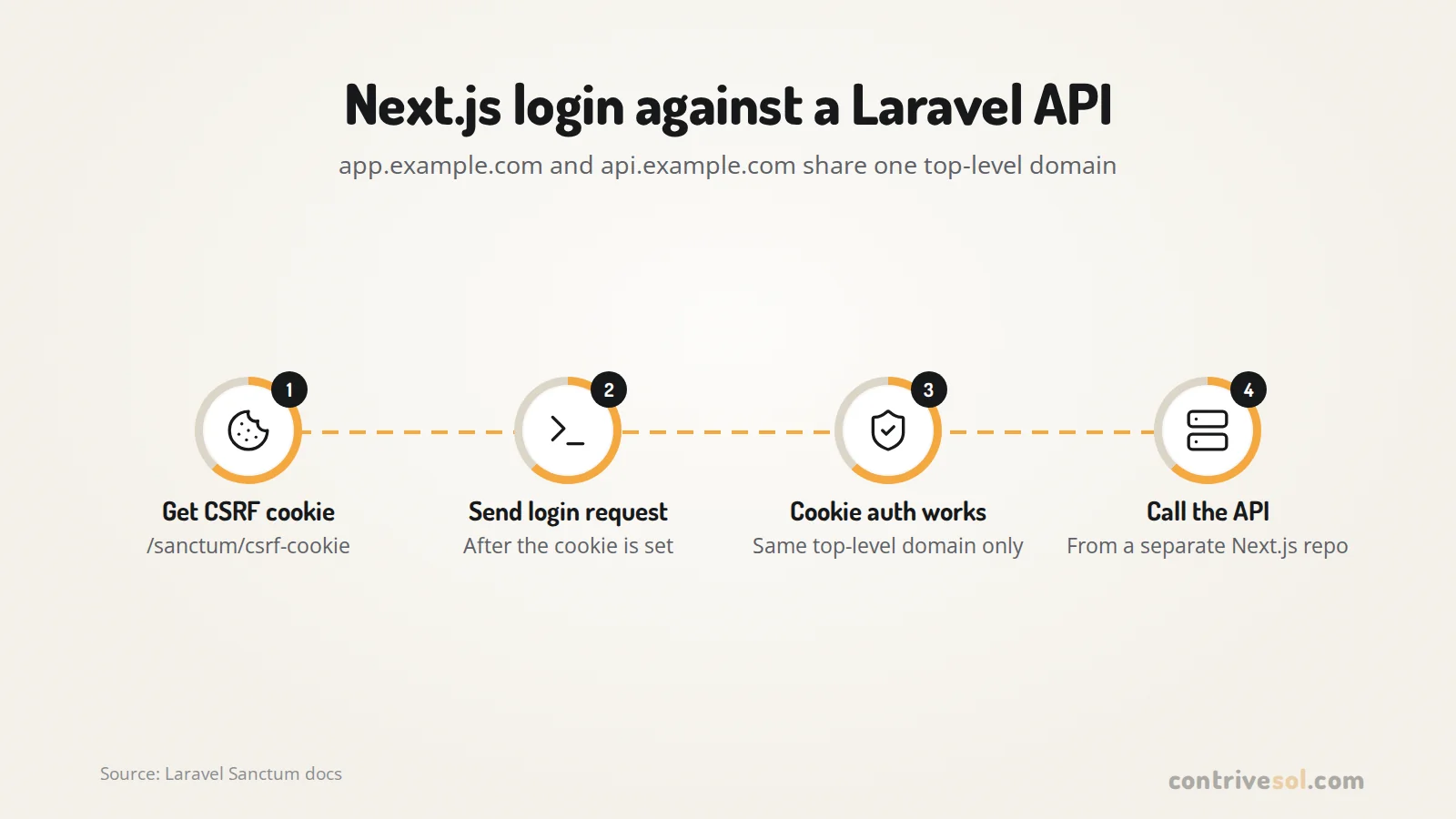
Yes, and Laravel documents the setup. Sanctum, Laravel’s API auth package, supports a separate single-page front end, including one built with Next.js or Nuxt in its own repository. The login page first calls /sanctum/csrf-cookie to set up CSRF protection, then sends the login request.
The main constraint is domains. For Sanctum’s cookie-based auth, the front end and API must share the same top-level domain, though they can sit on different subdomains. So app.example.com and api.example.com work together, while a front end on an unrelated domain can’t use cookie auth. Decide this before you set up hosting.
The split is a smaller jump than it looks. Laravel’s Vite build already needs Node.js 16 or newer and NPM, so a Laravel team runs Node tooling either way. Laravel 13’s JSON:API resources also give a separate front end a standard response format to consume. For the front-end side, our notes on instant navigations and partial prefetching in Next.js 16.3 cover a recent release.
How long is each version supported?
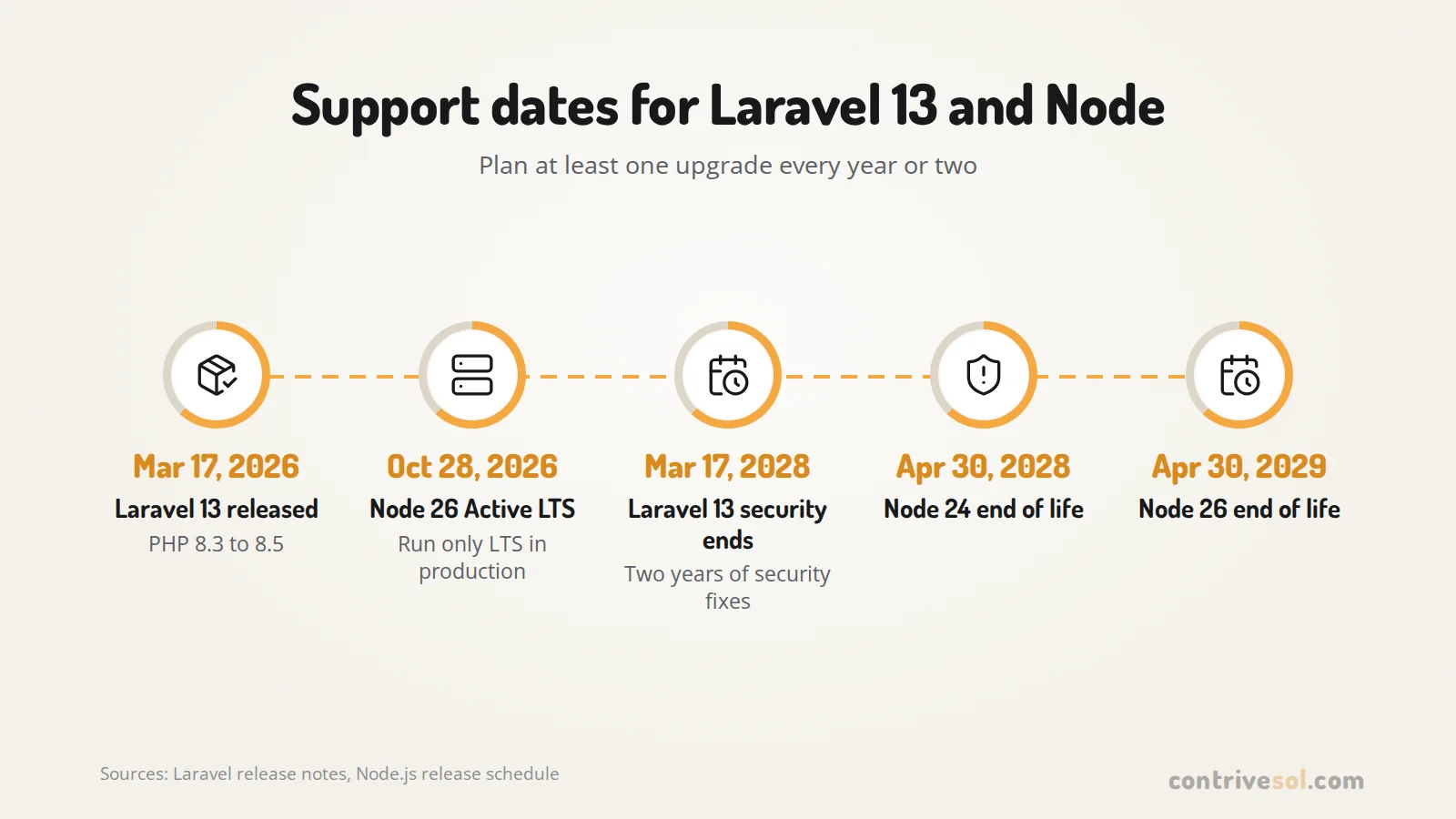
Laravel releases one major version a year, around Q1, and each gets 18 months of bug fixes and two years of security fixes. Laravel 13 came out on March 17, 2026, supports PHP 8.3 to 8.5 and gets security fixes until March 17, 2028. Laravel says most apps can upgrade to 13 without changing much code.
Node.js tells production users to run only Active LTS or Maintenance LTS releases. Node 26 became Active LTS on October 28, 2026 and reaches end of life on April 30, 2029, while Node 24 ends on April 30, 2028. From Node 27, Node moves to one major release a year, and every major becomes LTS. Each line then gets 30 months of LTS support, 36 months in total.
Both stacks need at least one planned upgrade every year or two, and skipping it is what gets expensive. In October 2026, PHP shipped critical security fixes with no patch for PHP 8.0 or 8.1. Our PHP2Shell patch guide covers that round. In the same cycle, Laravel Cloud dropped Node 20 because it had reached end of life and would get no more security patches.
npm also carries supply-chain risk. In September 2025, a self-replicating worm known as Shai-Hulud compromised more than 500 npm packages, according to a CISA alert. CISA told npm users to pin dependency versions to known-safe releases. Composer dependencies deserve the same care. Still, a NestJS or Express backend pulls in third-party packages for pieces Laravel ships itself, starting with the ORM, so there is more npm code on the server to watch.
Worked example: what does each stack cost to host?
Take an early-stage SaaS on one app server, with managed PostgreSQL and background jobs. Both versions use the same provider and the same deploy tool, so the stack is the only variable.
| Monthly item | Laravel | NestJS |
|---|---|---|
| Laravel Forge, Growth plan | $19.00 | $19.00 |
| DigitalOcean droplet, 4 GiB / 2 vCPU | $24.00 | $24.00 |
| Managed PostgreSQL, smallest node | $15.15 | $15.15 |
| Queue backend | $0, database driver | $15.00, managed Valkey for BullMQ |
| Total | $58.15 | $73.15 |
Forge works for both, since it deploys Node.js and Next.js apps as well as Laravel. The cloud provider bills the server separately from the Forge fee.
In our example, the only difference is the queue. Laravel can run jobs on the PostgreSQL database you already pay for, while BullMQ and Bull need Redis. DigitalOcean’s smallest managed Valkey node, a Redis-compatible store, costs $15.00 a month. Running Redis yourself on the same droplet would close the gap, but then you have to manage it.
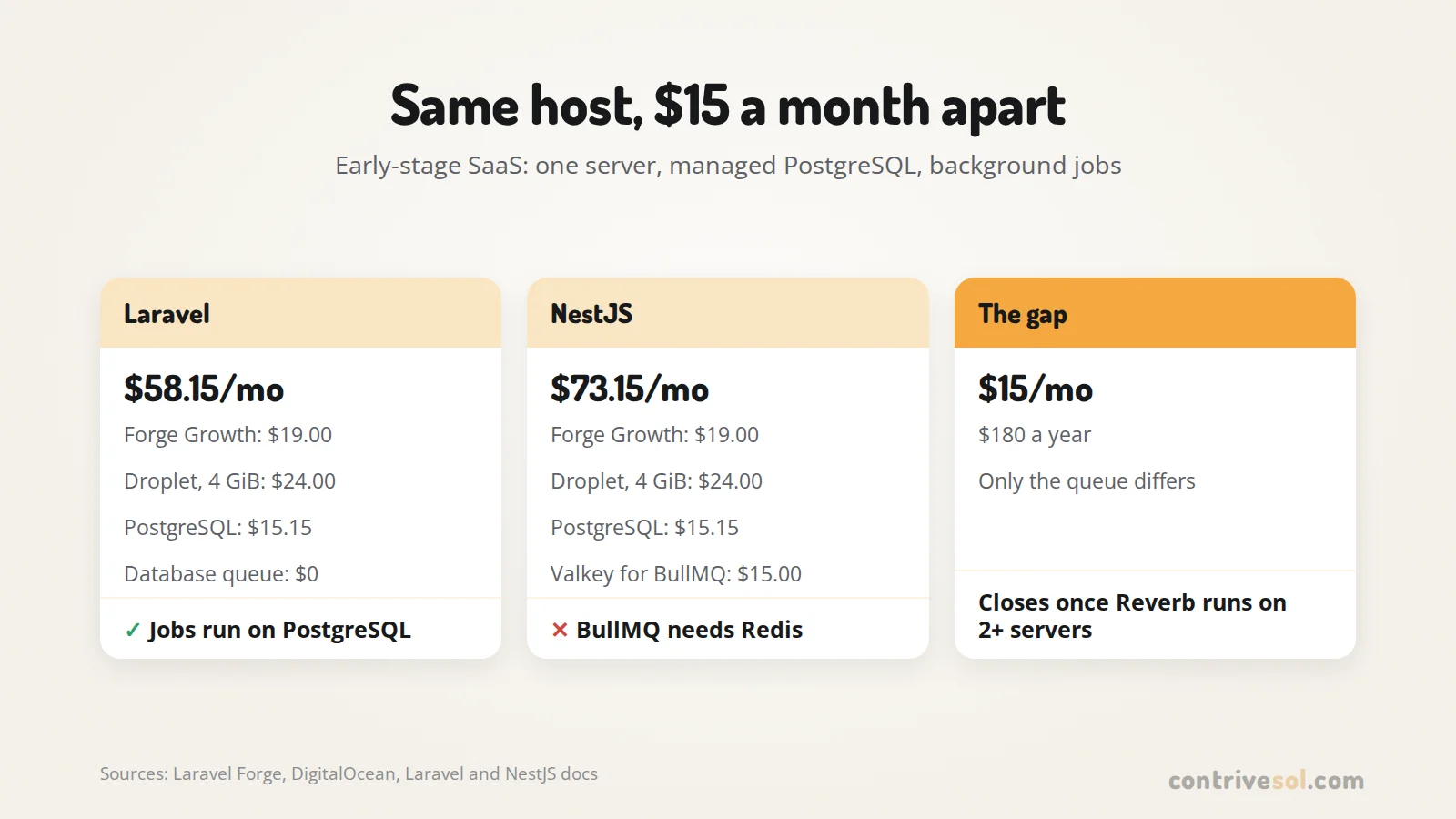
In our example, the gap is $15 a month, or $180 a year. That is about 0.2% of the global median back-end developer salary of $85,296. The gap also closes as you grow, because once Reverb runs on more than one server, Laravel needs Redis too. Hosting won’t decide this choice. Build time and the people you hire will.
If you’d rather not manage servers, Laravel Cloud’s Growth plan costs $20 a month plus usage. Laravel’s own calculator puts usage for its “SaaS MVP app” scenario at about $45.71 a month, assuming 240 awake hours, a 20 GB MySQL database, 1 GB of Valkey and two 2 GiB workers. If the plan fee is on top, that comes to about $66 a month. Treat it as the vendor’s estimate for one setup.
When is Laravel or Node.js the wrong choice?
Most bad fits come down to workload shape or team skills.
- Skip Laravel when the core workload is heavy real-time traffic across many servers and nobody wants to run Redis or tune event loops and open-file limits. A Node service with socket.io or ws gateways is the simpler path.
- When the whole team writes TypeScript, Laravel means switching to PHP. NestJS keeps that team in one language.
- Octane is risky if nobody has audited the code for state kept in memory between requests. Stay on standard PHP until you have a measured reason to switch.
- Express is the wrong pick for a small team that needs auth, billing, teams and admin quickly. It leaves the ORM and structure to you, and we found no Cashier-style billing package in the Node frameworks we reviewed. Use Laravel, or NestJS if the team must stay in TypeScript.
- Don’t run heavy computation, such as large reports or image processing, on Node’s main thread. One slow callback stalls every client, so move that work to a queue or a separate service.
- Choosing NestJS for a bigger hiring pool doesn’t hold up. Fewer 2026 survey respondents used NestJS (5.8%) than Laravel (7.6%).
- Neither stack belongs on an unsupported runtime, as the October 2026 PHP and Node 20 cutoffs showed.
Laravel vs NestJS vs Express at a glance
| Attribute | Laravel | NestJS | Express |
|---|---|---|---|
| What it is | Full-stack PHP framework | Structured Node.js framework | Minimal Node.js framework |
| HTTP layer | Standard PHP or Octane | Express by default | Itself |
| Auth | Starter kits with 2FA, passkeys package | @nestjs/authentication in docs | Not built in |
| Team accounts | Starter-kit option | Not found in docs | Not built in |
| Subscription billing | Cashier for Stripe | Not found in docs | Not built in |
| ORM | Eloquent, built in | Your choice: TypeORM, Prisma and others | Your choice |
| Queues | SQS, Redis or database | BullMQ or Bull, Redis required | Not built in |
| WebSockets | Reverb, Redis to scale out | socket.io or ws gateways | Not built in |
| AI tooling | First-party AI SDK, pgvector search | Vercel AI SDK | Vercel AI SDK |
| Runtime support | PHP 8.3-8.5 for Laravel 13 | Node LTS, 30 months from Node 27 | Node LTS, 30 months from Node 27 |
| 2026 survey usage | 7.6% | 5.8% | 15.6% |
| Raw throughput (synthetic) | Lower | Not in the source | Higher |
Frequently asked questions
Is Laravel still relevant in 2026?
Yes. Laravel 13 came out on March 17, 2026, supports PHP 8.3 to 8.5 and gets security fixes until March 17, 2028. It added a first-party AI SDK for text, tool-calling agents, embeddings and vector stores. In Stack Overflow’s 2026 survey, 7.6% of web-framework respondents used Laravel.
Is PHP a dying language?
Current usage says no. In Stack Overflow’s 2026 survey, 17.7% of respondents used PHP, compared with 62.0% for JavaScript and 43.8% for TypeScript. PHP is still maintained: it shipped critical security fixes in October 2026, though versions 8.0 and 8.1 got no patch. Laravel 13, released in March 2026, runs on PHP 8.3 to 8.5. The real risk is running an outdated PHP version.
Can Node.js replace PHP?
For many web backends, yes. Node.js serves many clients on few threads and handles I/O-bound work well, but its docs warn that expensive computation may not be a good fit. Node is a runtime, so you also pick a framework: Express is minimal and leaves the ORM to you, while NestJS adds a ready-made structure.
Do I need Node.js for Laravel?
For the front-end build, yes. Laravel compiles assets with Vite, and its docs say Node.js 16 or newer and NPM must be installed before you run Vite and the Laravel plugin. The PHP application itself doesn’t run on Node. Because a Laravel team already has Node installed, pairing a Laravel API with a separate Next.js front end is a smaller step than it sounds.
Does Laravel scale?
It can, with known limits to plan for. Octane keeps the app booted in memory between requests, on FrankenPHP, Swoole or RoadRunner. Reverb shares WebSocket connections across several servers through Redis pub/sub. Fathom Analytics’ co-founder, who runs Fathom on Laravel, wrote in 2022 that it is “a fantastic choice for 99.99994%+ of web applications”. That is one practitioner’s opinion, so test your own workload.
If you’re picking a backend for a new product and want these trade-offs checked against your features and team, see our SaaS development services.